
People talk about gearboxes because gearboxes are visible in the parts list. The diff ratio sits quietly at the back of the drivetrain, multiplying every gear and changing the whole personality of the car.
What the number means
The final drive ratio is simple. If first gear is 3.50:1 and the diff is 3.90:1, the overall reduction is 13.65:1. The engine turns 13.65 times for one turn of the wheel. Change the diff to 4.30 and first becomes 15.05 overall. The car feels sharper because the engine has more leverage over the tyres. It also runs out of revs sooner.
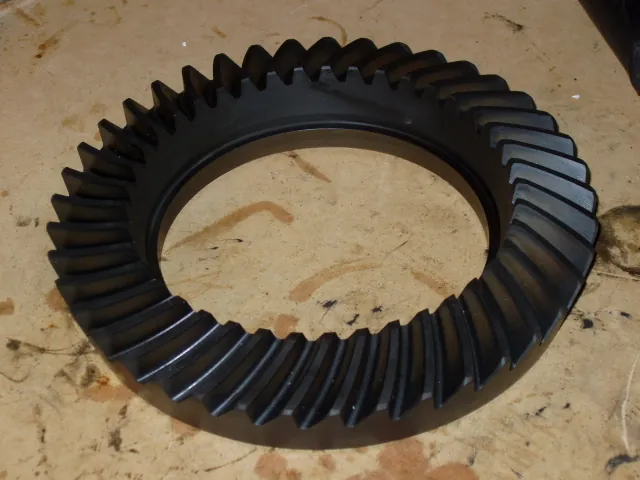
The ratio itself comes from tooth counts. It is the number of teeth on the crown wheel divided by the number on the pinion. A 43-tooth crown wheel and an 11-tooth pinion gives 3.91. A 41 and an 11 gives 3.73. That is why diff ratios come in odd, specific numbers rather than tidy ones. You pick from what exists for your axle, not from what sounds nice.

Shorter and longer, and which way the numbers go
The naming trips people up, so here it is plainly. A shorter final drive means a higher number. A longer final drive means a lower number.
A shorter final drive improves acceleration feel, helps an engine stay in the useful rev range and can make a lazy car feel alive. It also raises cruising RPM, increases noise and reduces speed in each gear. Go too short and first gear becomes a ceremonial gesture before second.
A longer final drive reduces RPM at speed, can improve motorway manners and may suit torquey engines. Go too long and the car feels flat, especially if the engine needs revs to work.
A worked example
Take an example five-speed with ratios of 3.14, 1.89, 1.33, 1.00 and 0.81, on a 205/55R16 tyre, with a 6,500 rpm redline. Here is what three different diffs do to it:
| Final drive | 1st at 6,500 | 2nd at 6,500 | 5th at 6,500 | RPM at 70 mph in 5th |
|---|---|---|---|---|
| 3.64 | 68 km/h | 113 km/h | 263 km/h | about 2,790 |
| 3.90 | 63 km/h | 105 km/h | 245 km/h | about 2,990 |
| 4.30 | 57 km/h | 95 km/h | 222 km/h | about 3,290 |
Look at what actually changes. Against the 3.90, the 4.30 costs about 6 km/h at the top of first and adds about 300 rpm at a motorway cruise. In exchange, every gear has about 10 percent more leverage. Whether that trade is worth it depends entirely on the car and the job.
Top speed is where people get caught
Top speed is where the diff catches people out. A longer diff gives a higher theoretical speed in each gear, but the engine still needs enough power to pull it. The 263 km/h fifth gear above is a number on a chart, not a promise. Most cars run out of power against drag long before they run out of gearing.
A shorter diff may reduce theoretical top speed, but the car might accelerate harder and reach its useful speed more quickly. On a lot of real cars, a slightly shorter diff means top speed arrives nearer the power peak and the car actually goes faster at the end of the straight. The right answer depends on the job.
The diff and the tyres are one system
Diff ratio also interacts with tyre size. Taller tyres act like a longer diff. Shorter tyres act like a shorter diff. If you fit taller wheels and tyres, then complain that the car feels slower, the diff may not be the only problem, but it is part of the conversation. A 4.4 percent taller tyre on a 4.10 diff drives like a 3.93. Sometimes the cheapest diff change is a different tyre.
Why a diff swap can transform a car
This is why diff swaps can transform a car. A road car that screams at 70 mph may need a longer final drive or a taller top gear. A track car that falls out of the power band may need a shorter diff. A drift car may need the right wheel speed in third, not the highest top speed. An engine swap often brings more torque, and more torque can carry a longer diff than the original engine could.
Before you buy one
A few practical checks save a lot of grief.
- Does the ratio exist for your axle? Check what crown wheel and pinion sets are actually made for your diff casing. Sometimes the cheapest route is a complete diff from another model that shares the casing.
- The speedometer will change. On cars that read speed from the gearbox output or a sensor before the diff, a new ratio changes the reading. Budget for a correction.
- Setup matters. Crown wheel and pinion sets need correct backlash and bearing preload. Fitted badly, they whine and then they fail. This is a specialist job for most people.
- LSD is a separate question. A limited-slip diff changes how power is shared between the wheels. It does not change the ratio. Do not confuse “I need a new diff” with “I need a shorter diff”.
Model it before you pay for it
Before buying a diff, model the whole drivetrain. Gearbox ratios, final drive, tyre size and redline belong in the same calculation. BoxSelector shows the effect across every gear, which is much more useful than arguing over whether 3.73 sounds sportier than 3.45.
The diff is not an afterthought. It is one of the main controls for how the car feels.