
Tyre size changes gearing because tyres are the final part of the drivetrain. Every gearbox ratio and diff ratio eventually turns the tyre. The tyre diameter decides how far the car travels for each wheel revolution.
A taller tyre travels further per revolution. That makes the effective gearing longer. At the same RPM, the car goes faster. Cruising revs drop. Acceleration may feel softer. Speedometer readings change.
A shorter tyre travels less far per revolution. That makes the effective gearing shorter. The car may feel sharper, because the engine gets through the rev range sooner. It may also become busier on the motorway and lose speed in each gear.
Reading the sidewall
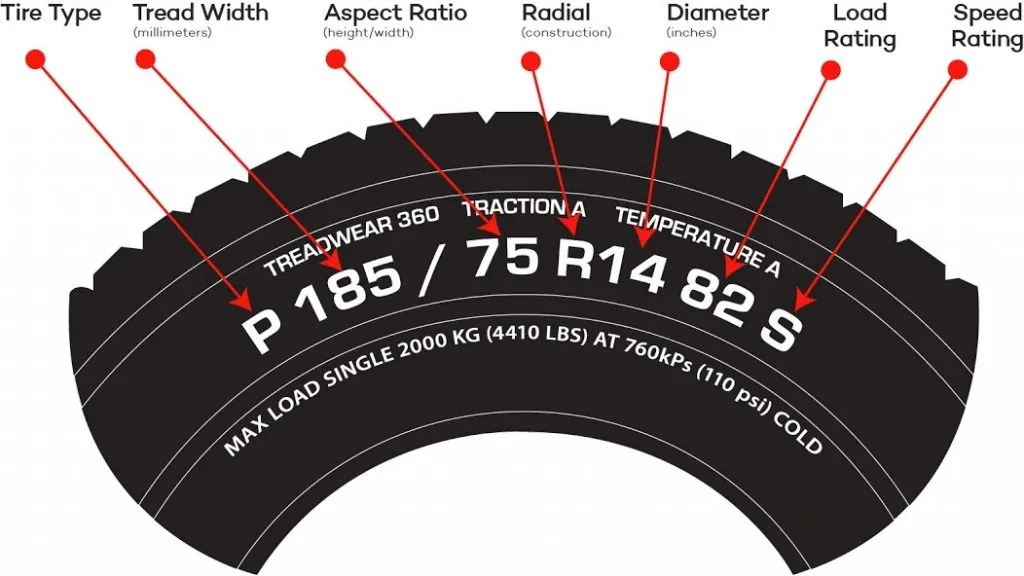
The sidewall code tells you the basics. Take 205/55R16:
- 205 is the tyre width in millimetres.
- 55 is the sidewall height as a percentage of width. This is the aspect ratio.
- R means radial.
- 16 is the wheel diameter in inches.
Yes, it mixes millimetres and inches. Nobody is proud of it. After the size you will usually see a load index and a speed rating, such as 91V. Those do not change the gearing, but they do matter. Fit a tyre with a lower load index or speed rating than the car needs and it can cause problems with your insurer, and an MOT tester may fail it.

Working out the diameter
The sidewall height is 55 percent of 205, which is 112.75 mm. The wheel diameter is 16 inches, or 406.4 mm. Add two sidewalls and the wheel:
112.75 + 112.75 + 406.4 = 631.9 mmThat is the approximate overall tyre diameter. For gearing you want circumference, which is diameter times pi:
631.9 x 3.1416 = 1985 mmSo each wheel revolution moves the car about 1.99 metres. That works out at roughly 504 revolutions per kilometre.
One honest caveat. Those are unloaded numbers. With the car sitting on it, the tyre squashes a little, so the effective rolling radius is slightly smaller than the sum says. Tread wear takes a few millimetres off too. The error is small and consistent, which is why the calculation is still the right way to compare sizes. It is a comparison tool, not a laser measure.
Comparing sizes
The comparison that matters is against the old tyre. Here are some common sizes against a 195/60R15, the sort of thing plenty of older cars left the factory on:
| Size | Diameter | Change vs 195/60R15 |
|---|---|---|
| 195/60R15 | 615 mm | baseline |
| 215/45R17 | 625 mm | +1.7% |
| 205/55R16 | 632 mm | +2.7% |
| 225/45R17 | 634 mm | +3.1% |
| 225/40R18 | 637 mm | +3.6% |
| 245/40R18 | 653 mm | +6.2% |
| 225/45R18 | 660 mm | +7.3% |
If the new tyre is close in diameter, the gearing barely changes. If it is several percent taller, the car will act as if you fitted a longer final drive. If it is several percent shorter, it will act as if you fitted a shorter one. A 7 percent change is roughly the difference between a 3.90 and a 3.64 diff. That is a real gearing change, made by accident.
A common rule of thumb is to keep the new diameter within about 3 percent of the original. It is not a law, but it keeps the speedometer, the gearing and the ABS roughly where the car expects them.
The speedometer problem
Most speedometers count revolutions somewhere in the drivetrain, not distance travelled. Fit a taller tyre and the car covers more ground per revolution than the speedometer thinks, so it reads lower than your true speed. A shorter tyre makes it read higher.
In the UK and Europe, speedometers are built to read at or above true speed, never below, and most read a little high from the factory for that reason. A much taller tyre can eat that margin and push the reading below your real speed. That is not a clever way to go faster. It is a way to get a letter in the post.
Why wheel upgrades cause surprises
This is why wheel upgrades can create surprises. Going from a small wheel with a tall sidewall to a bigger wheel with a low-profile tyre can keep the diameter similar. Going bigger without dropping enough sidewall makes the whole package taller. The car may look better but feel slower.
The trick is to change the aspect ratio as the wheel grows. Each inch of wheel adds 25.4 mm of diameter, so the sidewalls have to shrink by about 12.7 mm each to keep things level. That is why a 16 on a 55 profile tends to become a 17 on a 45 or an 18 on a 40.
Tyre width is a separate issue. Wider tyres can add grip, drag and weight, but diameter is the key gearing number. Wider also means a taller sidewall at the same aspect ratio, because the ratio is a percentage of the width. A 225/45 has a taller sidewall than a 205/45. Small detail. Real effect.
Put the real size in the calculator
BoxSelector uses tyre size to work out speed in each gear and cruising RPM, so it is worth entering the size you will actually run, not the size that came on the car in 1998. Try both. The difference between the two tables is the gearing change you are about to buy.
Tyres are not just fitment. They are gearing, speedometer behaviour, ride height, acceleration feel and running cost all rolled into one black circle. Ignore them and the car will teach you anyway.